Top 6 Hot Springs soaks in Colorado

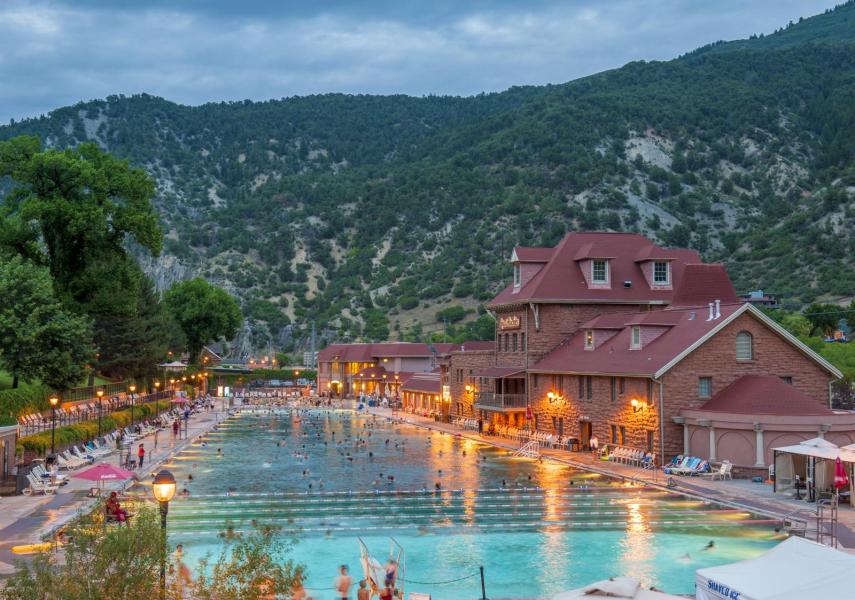
Photo by Glenwood Hot Springs Resort

Glenwood Springs was first. The strong smell of sulfur and the scratch of concrete on our bare feet. I think it may be more bougie now, but it is still hot. I remember thinking that the first pool was so hot it may have literally touched the earth’s core. My young siblings and I dared each other to jump in, or even to dip a toe, before we headed to the milder, larger warm pool that seemed to go on forever. Apparently its the largest hot springs pool in the world!

“I can still touch here,” we would exclaim to one another and to our parents, as we bobbed along all the way to the deep end, its diving boards, and an inevitable sunburn in the high-altitude swim.

My young husband and I ended up back in Glenwood again for our honeymoon. It was unexpected, a sort of punt after the cruise line we’d booked went bankrupt. We kept returning wedding gifts at the Glenwood Walmart to extend our stay at the honeymoon suite at the Silver Spruce Inn and then cheaper Starlight Lodge. A set of six glass tumblers and some mixing bowls afforded us a few more days of hiking, soaking, and fine dining at the Village Inn. I think couples plan more today and have more money. But are they the happier for it? Debatable.

We were married in late December, and if you’ve never been in a Colorado hot springs in winter, know this: it’s magic. Pillows of steam rise from the water, wrapping swimmers in mystery and privacy as they glide through the warm, mineral-rich pool. Pure joy.

Three years later, we landed in Norwood, Colorado, not far from Ouray, another hot springs haven. We’d often drive the hour to soak in the mineral baths while our preschool daughter swam circles around us. We’d lean back, relax, and scan the red cliffs for mountain goats.
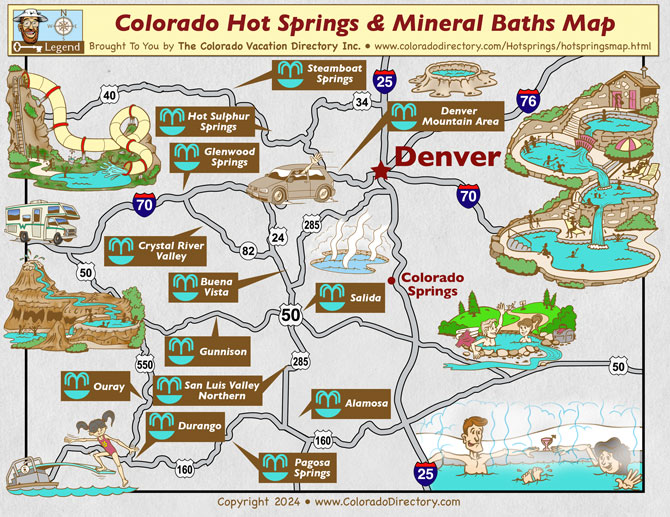

Colorado Hot Springs Map

Another daughter later and we headed again to Glenwood, and then more regularly down from Grandma and Grandpa’s place in the center of the state to Mt. Princeton Hot Springs near Buena Vista. They had a frequent swimmer punch card!

At that time, Mt. Princeton wasn’t much—just a cave-like reception area, a basic rectangular pool, and a path down to Chalk Creek, where the real magic happened. Hot water bubbles up beneath the sandy creek bed, and visitors build rock pools right in the stream, mixing hot and cold flows to find the perfect soak. The kids loved experimenting, damming one side, letting cold water in the other. It’s a little more fancy now, and definitely much more expensive, but the creek is still the best part.

In more recent years, we’ve added new springs to our travelogue. Pagosa Springs, near Durango, charmed us with its location right in town but somehow still holding onto a nature vibe. Strawberry Hot Springs, near Steamboat, delivered an entirely different experience—hippie vibes, clothing optional after dark, and a sketchy unisex changing room with raggedy curtains. After a day of skiing we braved the snowy stairs on prickly bare feet to sink into the steamy and crowded, but warm and lovely pools.
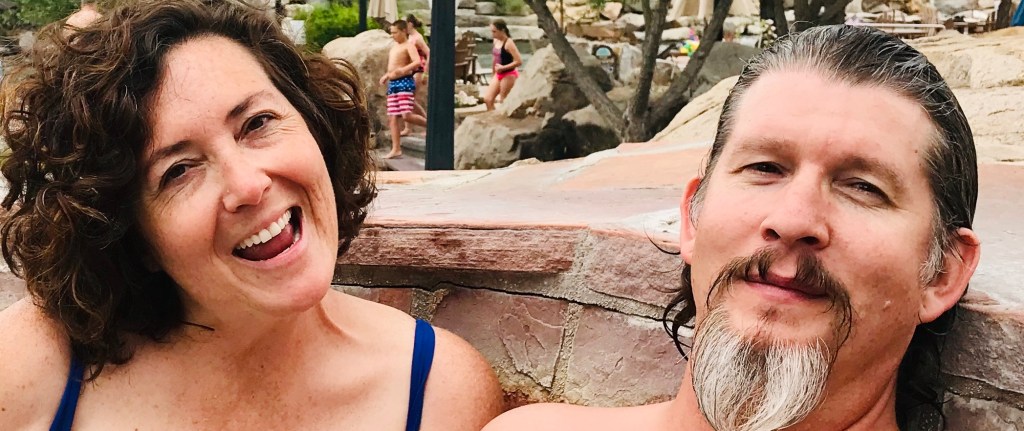
Me and the Hubs at Pagosa Springs, Colorado, in 2019.

Our favorite hot spring discovery lately is the redeveloped Iron Mountain Hot Springs, the second major spring in Glenwood. It features over a dozen small pools made of red rock, sand, and pebbles, blending into the high desert aesthetic and offering unique temperatures marked with metal signage. Regular adjustments with cool Colorado River water offset the natural 112°F heat.

The best part? Choice. Want to stay in a toasty 105°F? Done. Prefer a milder 99°F? Just down the walkway. My personal favorite is 103°F. Every body is different.

Some pools are close enough to hear the river; others let you sit and watch it flow by. Bathers soak surrounded by foothills, eagles—and the glow of lights from the big box stores across the water.

We still have plenty of hot springs left to try. So when we find our next favorite soak—I’ll be sure to let you know.

###

Art for joy’s sake

Some art is created to dissolve.

Ice sculptures. Sandcastles. Chalk paintings on pavement. Ron and I walked around the Denver Chalk Art Festival this year and glimpsed some wildly colorful works chalked onto the streets. The bold palettes seemed to take their cues from tattoos, or street murals. And, despite the fact that the artists were painting down on the ground, many managed to add enlivening dimensions to their asphalt canvases.

The frog’s classic dilemma.

Chalk artistry is one of the most optimistic and free expressions of art. Hours are spent drawing, shading, and adding detail, all for the sake of a creation that disappears within days, maybe hours if it rains. Transient art reminds us that everything will pass. Maybe that’s also why I blog.

Bright butterflies take flight from three-dimensional bricks chalked on the street.

Some art wants you to feel something.

Set in the same Denver block as the chalk art festival is the Clyfford Still Museum. I stepped inside this ultra-modern edifice on one of its free days a few weeks ago. It was built specifically to house nearly all the paintings by American artist Clyfford Still (1904-1980).

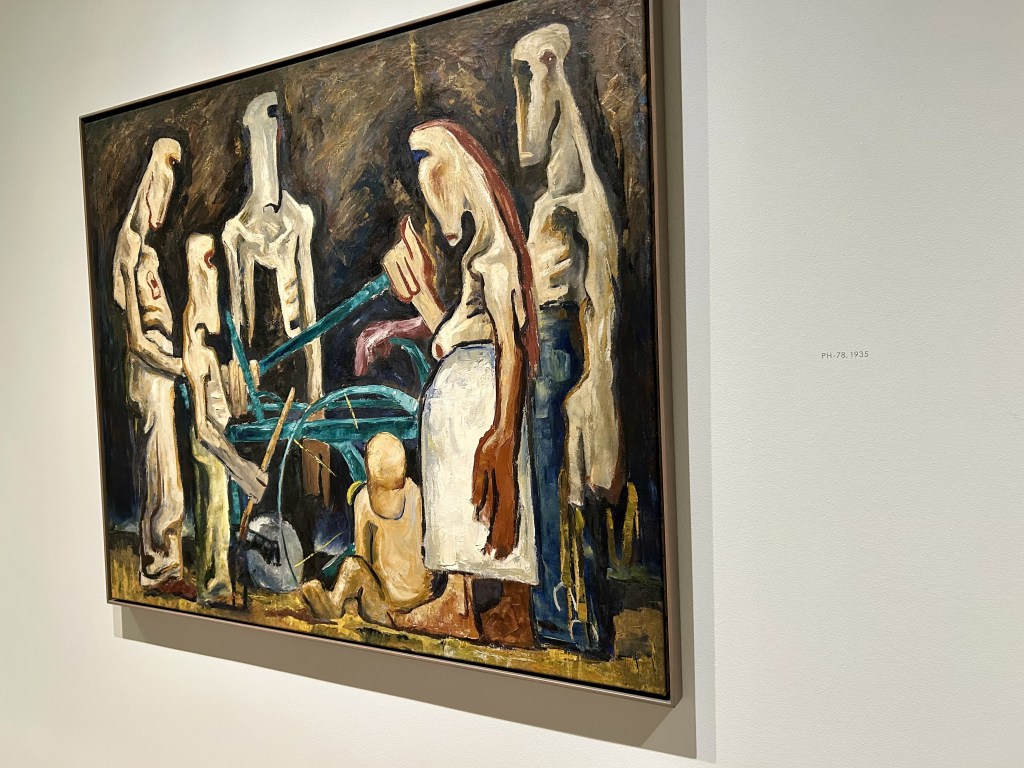
These are Clyfford Still’s horse-face people.

Arranged to show Still’s journey as an artist, the exhibit began with works from The Great Depression era. Still painted horse-faced people whose skin drapes thick over their protruding bones, hands dangling like oars at their sides. Following World War II, Still became an abstract expressionist of the 1950s. He was counted along with Jackson Pollock and Mark Rothko, and a dozen others in this movement.

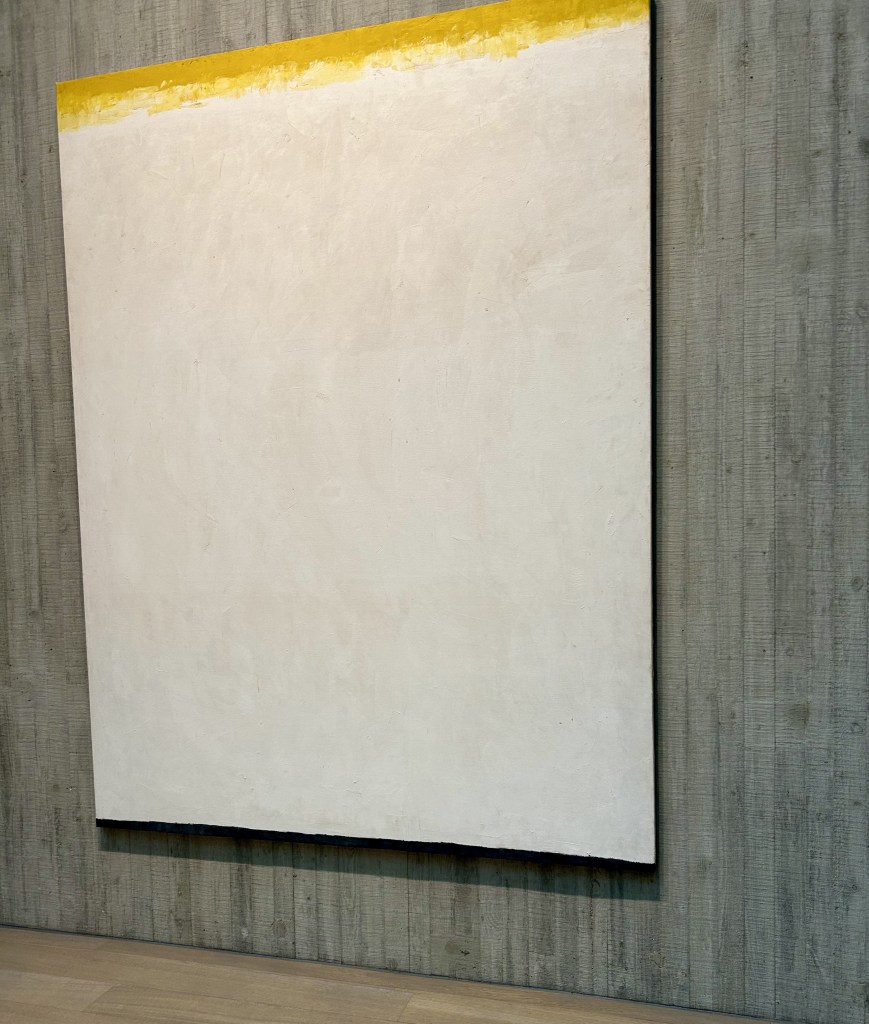
What is the feeling elicited from a massive white square bounded at the top with a blurred gold? Heaven? Ennui? Or perhaps the happy emotion of something being clean and uncluttered.

Still used enormous canvases. He was right doing that, I think. Feelings can be big. He painted giant swaths of one or two colors. He used jagged shapes, blocks, and lines. I like the horse-face people better. Abstract art has never compelled me. That doesn’t say as much about abstract art as it says about me.

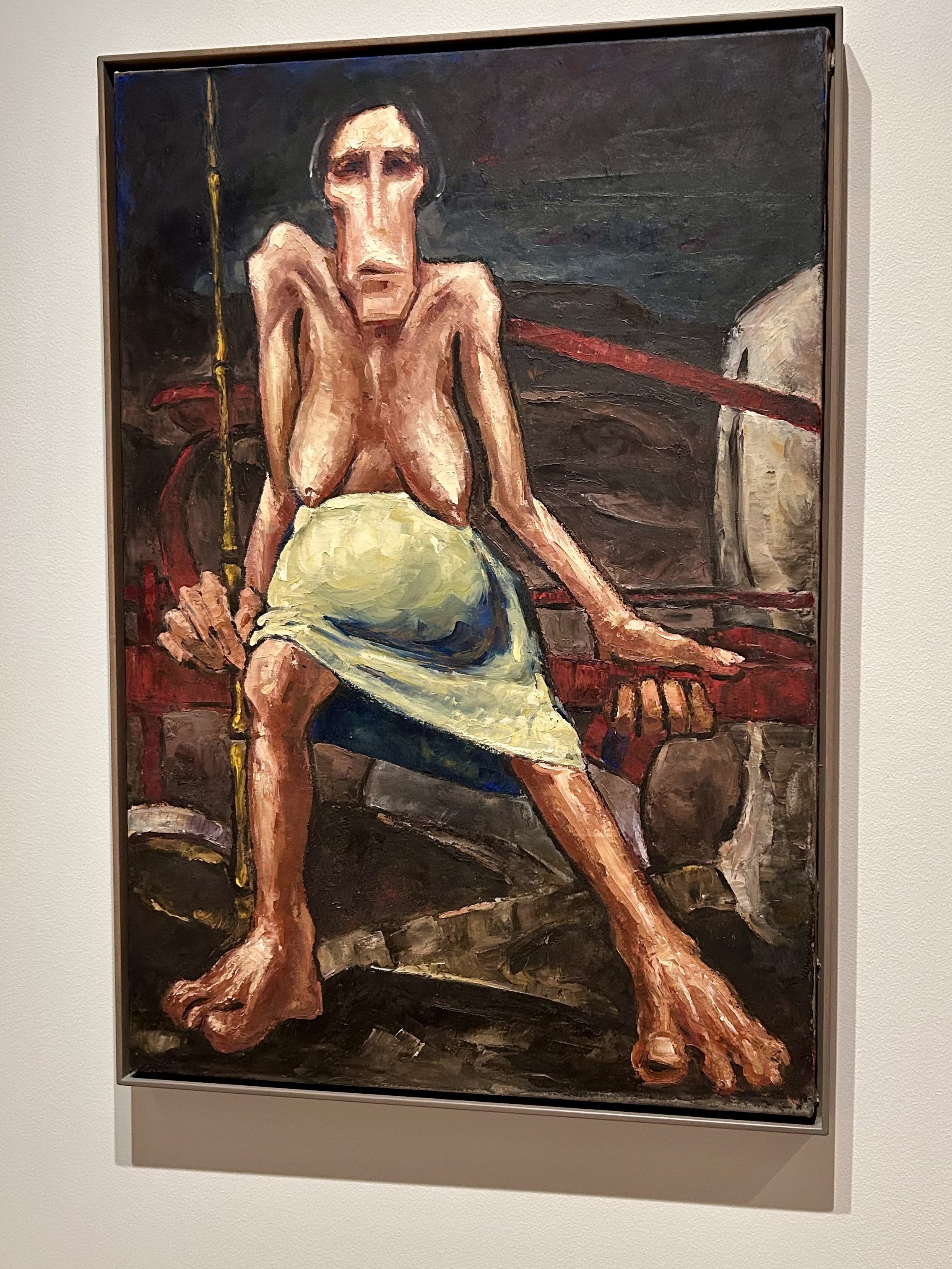
I related to the woman Still painted who seemed to me to embody the stage of life in which I now find myself; mid-50s, empty nest. Still’s work, PH 416 was like staring into a mirror. The woman sits shirtless for no apparent reason, large breasts hanging down slack and uneven, nipples shelved on a rounded lower belly bulging beneath a green skirt. She’s holding what appears to be a bamboo pole in one massive paw. Her face is long, like the others, and blank; emotionless. Here large toes, feet, and hands no match for her gaunt body, painted sinewy with deep contrasts. 

I am her, I think, as I gaze at the painting.

Then, I imagine Still tiring of this woman, and all the long faces. I consider the steps he took from these works to abstract painting. I try to make sense of his interest in art that would provoke emotion in viewers, rather than reveal it in those he painted.

Some art is found.

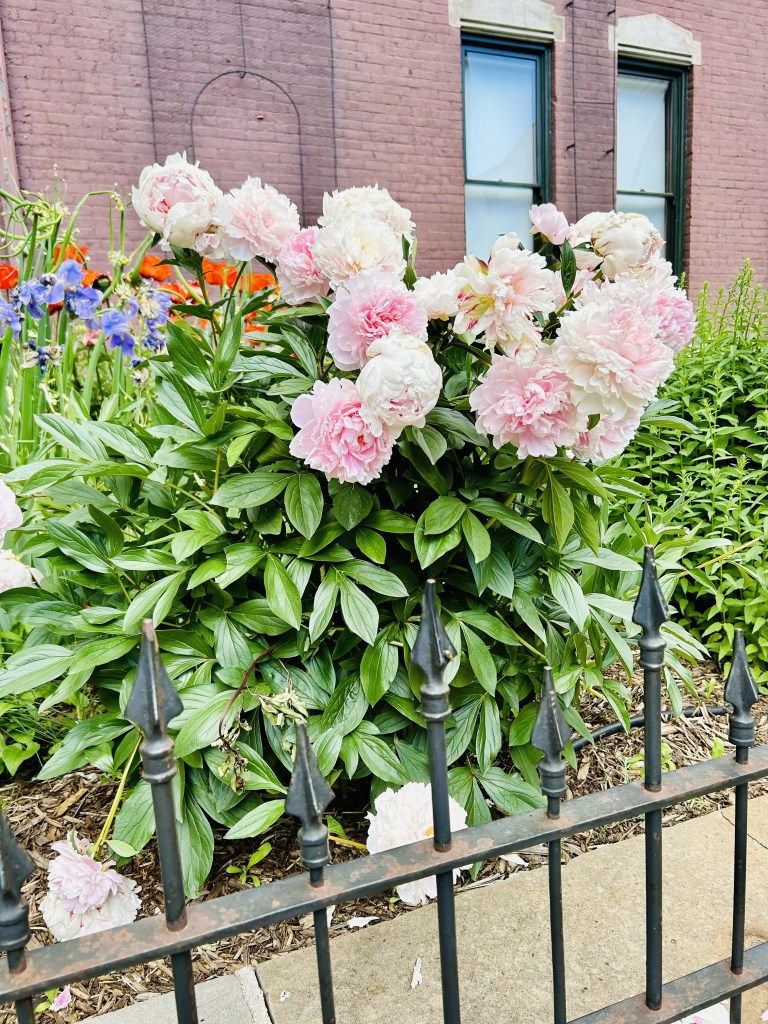
I wandered back to the bus stop, still thinking about the Still Museum paintings and stopped to notice the bright red poppies, and pale pink peonies guarded by a wrought iron fence at the Center for Colorado Women’s History. Maybe flowers are art. Maybe drawing or painting them is art. Do they convey emotion? Do they elicit it?

I’ve been reading The Supper of the Lamb: A Culinary Reflection by Robert Farrar Capon, and it’s a treasure trove of practical theology. Art and theology are as close as siblings I think, since God is a creator, and we are made in his image. Capon broadens the idea of art for art’s sake to encompass more than art. So, I think food, flowers, paintings, chalk or otherwise, abstract or representational, everything that has been made would be included in what Capon says exists simply for joy.

“The world exists, not for what it means but for what it is.” – Robert Farrar Capon

###

Last bike ride: a study in contrast

The bike path near our condo used to be the best feature of the area where we live near Old Town Littleton, Colorado. Maybe it still is, I can’t decide. 

The trail winds its way along Big Dry Creek for miles, then follows the South Platte River. A cyclist can ride all the way into Denver if you don’t mind the smell of pot, and occasional drug addicts ambling along. 

Go the other way and you’ll end up atop the Chatfield Reservoir Dam, winded and perhaps wishing you had driven, but awestruck by the purple mountain majesty and the sparkle of sun on the wide water. 

Sometimes I also take the bike trail from here all the way to the Highline Canal trail, which winds through the back of neighborhoods filled with mansions, manicured lawns, stables, and pools.

Either way, I see things.

Maybe that’s because I cycle like I walk — slowly. I guess you could say I’m going nowhere, fast, and that’s true in more ways than one, since I’m no longer working, and we don’t have any big travel plans this summer. But the slow pedaling keeps me humble. When I’m bicycling on the path I hear “on your left,” so frequently, even from skinny octogenarians who pass me at incredible rates of speed for their old bones, that I sometimes wonder if I’ve accidentally stopped altogether. 

Of course, when biking in Colorado, it’s important to remember that a lot of cyclists on the bike paths here are like a lot of hikers on the trails here—super serious. Me, not so much. My bike is old and crappy. I got it for 40 bucks on Facebook Marketplace. I don’t wear Lycra. I have no real cycling gear other than my helmet. I like a wicker basket between my handlebars so I can take home things like the vintage greeting cards I found at the thrift store on 50% off white tag day, or so I can bring along an apple to eat. I don’t have clip-in shoes. I wear worn sandals. I wear shorts and blouses, and cruise along at a speed that makes my heart pump faster but doesn’t endanger passing geese or have me accidentally ingesting the fluff floating in the air this time of year from the enormous Cottonwood trees. 

And I see things.

On weekends the path is very busy. There are a couple of beer pubs, a winery, and a coffee shop where a fiddler and a couple other string players sent music notes drifting through the breeze toward the river the day I passed by. The library bookmobile was parked there, too, I noted it, so I could check books out next time. That was when I thought there would be a next time.

I stumbled into the Paris Flea Market event at the Aspen Grove shopping center last Saturday. Reminded me of the actual Paris flea market Ron and I went to when we were in Paris several years ago. We bought some vintage tourist brochures with renderings of old chateaus. I framed a few and hung them. Of course, the Colorado version of the Paris market included lots of very American things, like tie-dye, country chic décor, and overpriced food trucks. I ate the apple I’d packed in my basket.

Then I road back the same way I had come and watched the river flow along, its deep water quiet and calm, flanked by lush willows and primrose bushes. I saw two dogs in backpacks, tongues hanging out, fur flowing in the breeze as they rode along with their cycling owners.

I only passed one other cyclist – he was pedaling a large cart like a rickshaw. It held two older, possibly disabled people. The sign on the cart said something about making cycling accessible. I actually thought at that moment that maybe I could help do that as well by writing about this path for people who could never bike along it. I didn’t think that would ever include me. 

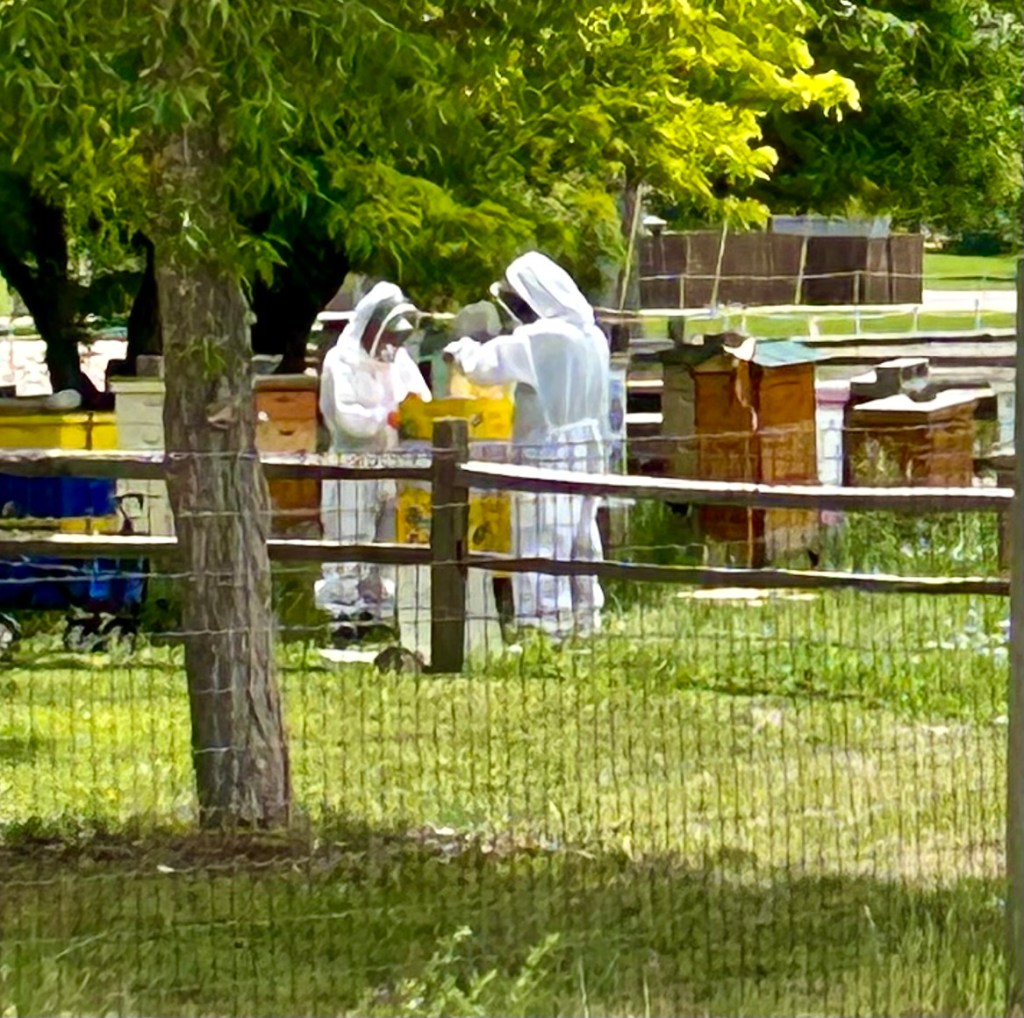
I saw beekeepers at the Hudson Gardens. 

I saw the 154-foot SpaceX rocket booster that arrived at its new home outside of the DISH Network Corporate Offices in Littleton last year. It was impressive! I’ve never found a tax deduction that large. Neither have I ever earned even a fraction of what the Dish chairman has lost. This is a guy who started by selling satellite dishes out of his car in the 1980s before his net worth literally skyrocketed to well over $20 billion a few years ago, according to Forbes. Sadly, he free fell back to earth with a mere $1.4 billion this year. But then, the economy of late has made most of us losers.

Not far from DISH are the benches where men hang out and sometimes build fires, or camp. They may be some of the 600 or so folks DISH has laid off in the last couple of years. I hope not, but as the latest innovation even at DISH illustrates, namely that of the no-dish satellite. No one wants a dish, or a cable anymore I suppose. We want our entertainment coming to our screens from nearly invisible sources, just like it did in the good old days of radio and antennae television. 

I pedaled under a couple more bridges and I was back along the creek. I pedaled past the dog park where a man frequently brings his Mexican wolf. To the dog park. He is the alpha male, obviously—the wolf, not the man.

Toward the end of my ride, I climbed up the hill to the place where a green miniature train follows a track around Belleview Park. Families lay out blankets and picnic along the wide, grassy banks of the creek there while their children wade into the water and squeal. None of them seem to have any idea that only a few months ago the former mini-train conductor was indicted for some sort of cottage-industry mortuary that turned foul; READ: corpses rotting in his hearse and cremations backlogged. (Fiction is less interesting than real life these days.)

I zoomed through the last tunnel. It’s off-and-on strewn with graffiti and then painted over in patches. I rattled across the final wood-planked bridge, and I was back within view of our condo. A birthday party for a three-year-old was just finishing. I braked for kids carrying balloons and packages to the parking lot then panted my way up the last hill to check my mail. I spotted the pickup truck where a woman sometimes lives.

I saw all those things. And I thought I would go on seeing them all summer on those trails. But today I walked by the bike rack on my way to the mail again, and our bikes were gone. The lock cable had been snipped like a string.

###

Haitian Inspiration Comes to Denver

I registered for the event twice. I looted my local library shelves of three Edwidge Danticat novels. I read her writing craft book electronically. Then I drove into downtown Denver past young professionals and homeless camps and arrived at the Saturday workshop this Haitian-born author was to lead. I was early. I sat in a front row seat, blood buzzing in my veins.

Writing is such a solitary activity that any event that pulls word pushers out from their lonely spaces to mingle, speak, and listen to others is bound to be full of inspiration. And because of the pandemic, it had been a year and a half since Danticat was supposed to have arrived in Denver to speak with other writers and readers. And suddenly, in she walked. 

She spoke about how COVID had showed people of every ilk what the solitary world of writers is like. 

“The world learned how writers live locked in a room, trying to get inspiration from the air,” she said.

She also spoke about the idea of mortality—which has consumed the world since February 2020. “So much of writing about death involves writing about life,” she said.

You may know Danticat and you may not. You may google her and read her stories, you may not. She is award-winning and well-published with nearly two dozen novels, short story collections, young adult and children’s books, memoirs, essays, and anthologies edited. She also holds an MFA in writing from Brown and honorary degrees from Smith and Yale. Her career and accomplishments are impressive. 

Most impressive this month was that she was also very generous. She listened as a few workshop participants read what they had written during the 10-minute exercise she led for us. She commented positively and asked to hear from others. She answered questions from the audience. I asked her about her writing process. And this was the most helpful thing to me since it is so similar to my own process. She said that her words don’t land gracefully on the page straight out of the chute, but that she edits heavily. 

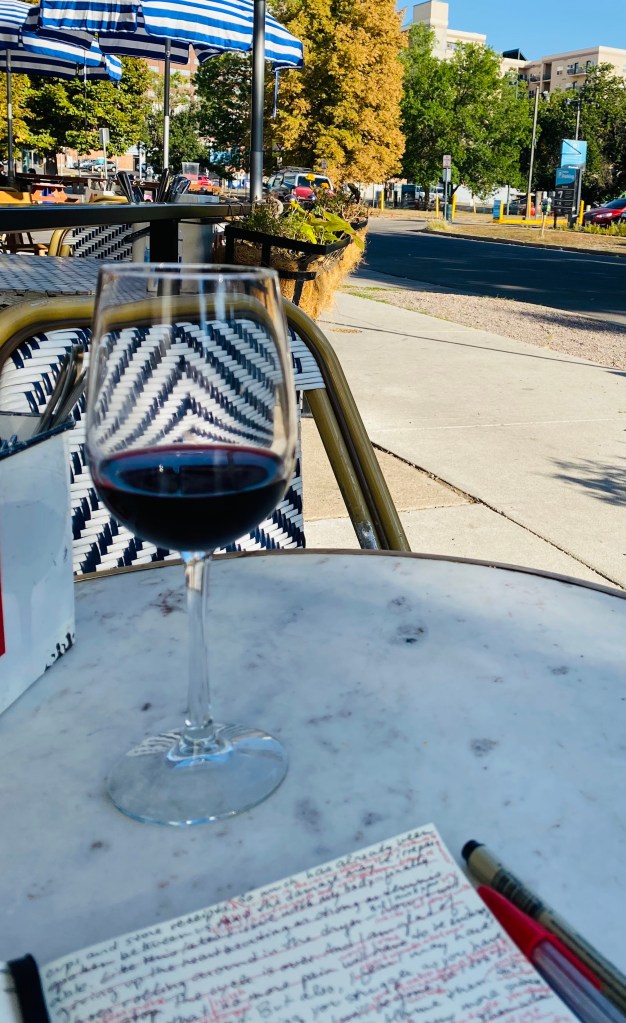
After the workshop with Danticat I sat at this sidewalk cafe table in Denver and worked on some editing.

This was a great relief to me. Raw talent would never be enough for me to land in Oprah’s Book Club—where Danticat has been since the early ‘90s. But editing heavily means that hard work pays off. 

Honing skills and working hard are for anyone with energy and drive. Talent and luck are sprinkled around more arbitrarily it seems. And of course, as Eminem so famously rapped, opportunity comes once in a lifetime. 

I’m so thankful to have had the opportunity to hear Danticat in Denver. I hope we are now best friends. Meeting her isn’t much of a travel story for this travel-themed blog. But the old adage that books take us to places we would otherwise never go, is true enough. And inspiration can also give us a ride further than any plane, train, or automobile. Hopefully this blog, though perhaps only a handcart on a railroad through the desert, can be some sort of transport for you as well. Thanks for reading.