Top 6 Hot Springs soaks in Colorado

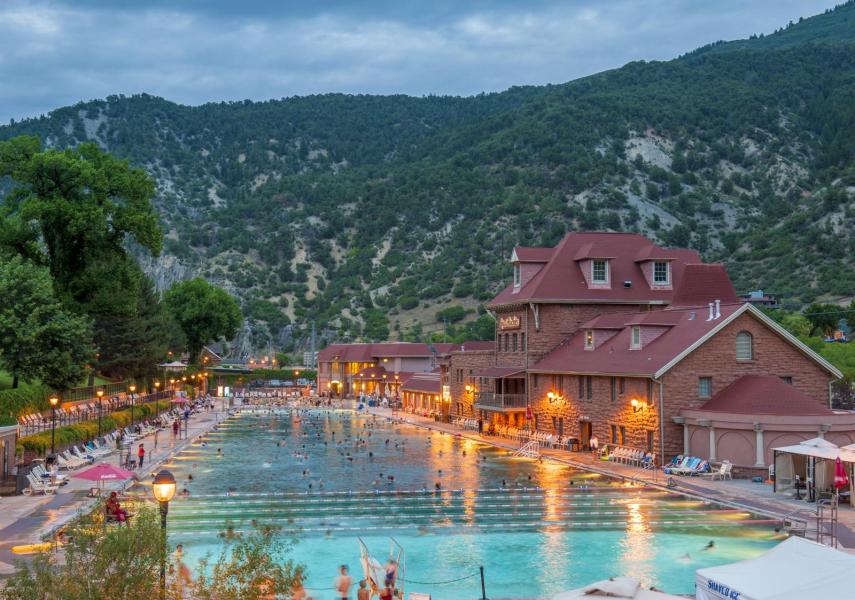
Photo by Glenwood Hot Springs Resort

Glenwood Springs was first. The strong smell of sulfur and the scratch of concrete on our bare feet. I think it may be more bougie now, but it is still hot. I remember thinking that the first pool was so hot it may have literally touched the earth’s core. My young siblings and I dared each other to jump in, or even to dip a toe, before we headed to the milder, larger warm pool that seemed to go on forever. Apparently its the largest hot springs pool in the world!

“I can still touch here,” we would exclaim to one another and to our parents, as we bobbed along all the way to the deep end, its diving boards, and an inevitable sunburn in the high-altitude swim.

My young husband and I ended up back in Glenwood again for our honeymoon. It was unexpected, a sort of punt after the cruise line we’d booked went bankrupt. We kept returning wedding gifts at the Glenwood Walmart to extend our stay at the honeymoon suite at the Silver Spruce Inn and then cheaper Starlight Lodge. A set of six glass tumblers and some mixing bowls afforded us a few more days of hiking, soaking, and fine dining at the Village Inn. I think couples plan more today and have more money. But are they the happier for it? Debatable.

We were married in late December, and if you’ve never been in a Colorado hot springs in winter, know this: it’s magic. Pillows of steam rise from the water, wrapping swimmers in mystery and privacy as they glide through the warm, mineral-rich pool. Pure joy.

Three years later, we landed in Norwood, Colorado, not far from Ouray, another hot springs haven. We’d often drive the hour to soak in the mineral baths while our preschool daughter swam circles around us. We’d lean back, relax, and scan the red cliffs for mountain goats.
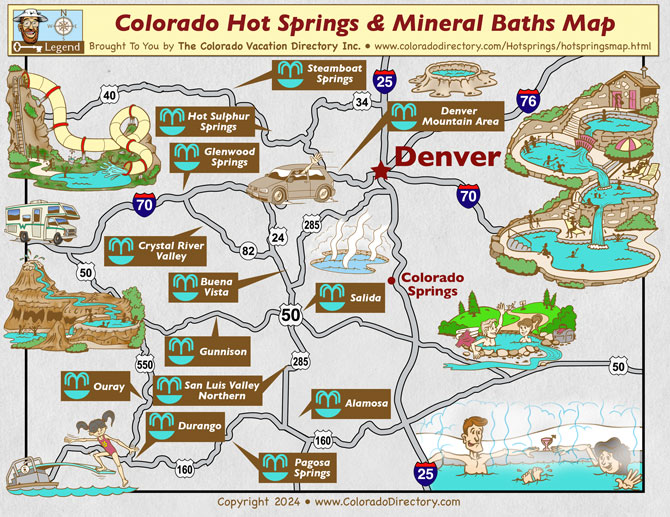

Colorado Hot Springs Map

Another daughter later and we headed again to Glenwood, and then more regularly down from Grandma and Grandpa’s place in the center of the state to Mt. Princeton Hot Springs near Buena Vista. They had a frequent swimmer punch card!

At that time, Mt. Princeton wasn’t much—just a cave-like reception area, a basic rectangular pool, and a path down to Chalk Creek, where the real magic happened. Hot water bubbles up beneath the sandy creek bed, and visitors build rock pools right in the stream, mixing hot and cold flows to find the perfect soak. The kids loved experimenting, damming one side, letting cold water in the other. It’s a little more fancy now, and definitely much more expensive, but the creek is still the best part.

In more recent years, we’ve added new springs to our travelogue. Pagosa Springs, near Durango, charmed us with its location right in town but somehow still holding onto a nature vibe. Strawberry Hot Springs, near Steamboat, delivered an entirely different experience—hippie vibes, clothing optional after dark, and a sketchy unisex changing room with raggedy curtains. After a day of skiing we braved the snowy stairs on prickly bare feet to sink into the steamy and crowded, but warm and lovely pools.
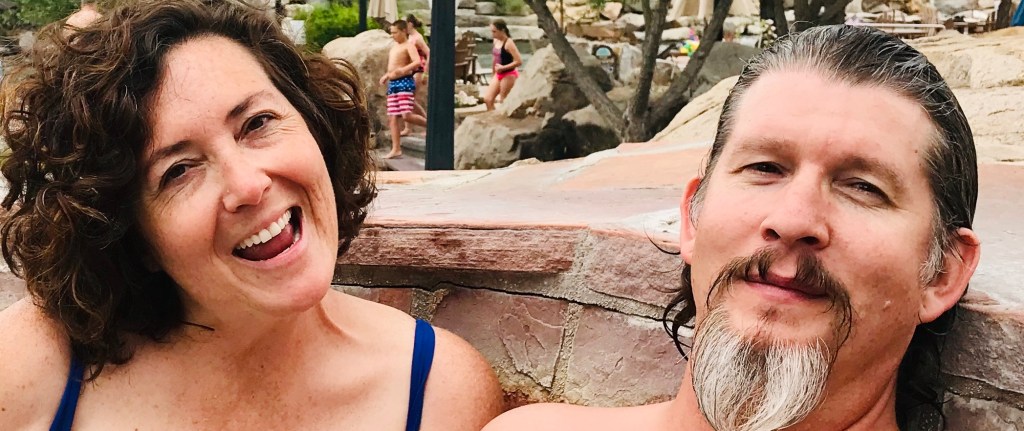
Me and the Hubs at Pagosa Springs, Colorado, in 2019.

Our favorite hot spring discovery lately is the redeveloped Iron Mountain Hot Springs, the second major spring in Glenwood. It features over a dozen small pools made of red rock, sand, and pebbles, blending into the high desert aesthetic and offering unique temperatures marked with metal signage. Regular adjustments with cool Colorado River water offset the natural 112°F heat.

The best part? Choice. Want to stay in a toasty 105°F? Done. Prefer a milder 99°F? Just down the walkway. My personal favorite is 103°F. Every body is different.

Some pools are close enough to hear the river; others let you sit and watch it flow by. Bathers soak surrounded by foothills, eagles—and the glow of lights from the big box stores across the water.

We still have plenty of hot springs left to try. So when we find our next favorite soak—I’ll be sure to let you know.

###

Last bike ride: a study in contrast

The bike path near our condo used to be the best feature of the area where we live near Old Town Littleton, Colorado. Maybe it still is, I can’t decide. 

The trail winds its way along Big Dry Creek for miles, then follows the South Platte River. A cyclist can ride all the way into Denver if you don’t mind the smell of pot, and occasional drug addicts ambling along. 

Go the other way and you’ll end up atop the Chatfield Reservoir Dam, winded and perhaps wishing you had driven, but awestruck by the purple mountain majesty and the sparkle of sun on the wide water. 

Sometimes I also take the bike trail from here all the way to the Highline Canal trail, which winds through the back of neighborhoods filled with mansions, manicured lawns, stables, and pools.

Either way, I see things.

Maybe that’s because I cycle like I walk — slowly. I guess you could say I’m going nowhere, fast, and that’s true in more ways than one, since I’m no longer working, and we don’t have any big travel plans this summer. But the slow pedaling keeps me humble. When I’m bicycling on the path I hear “on your left,” so frequently, even from skinny octogenarians who pass me at incredible rates of speed for their old bones, that I sometimes wonder if I’ve accidentally stopped altogether. 

Of course, when biking in Colorado, it’s important to remember that a lot of cyclists on the bike paths here are like a lot of hikers on the trails here—super serious. Me, not so much. My bike is old and crappy. I got it for 40 bucks on Facebook Marketplace. I don’t wear Lycra. I have no real cycling gear other than my helmet. I like a wicker basket between my handlebars so I can take home things like the vintage greeting cards I found at the thrift store on 50% off white tag day, or so I can bring along an apple to eat. I don’t have clip-in shoes. I wear worn sandals. I wear shorts and blouses, and cruise along at a speed that makes my heart pump faster but doesn’t endanger passing geese or have me accidentally ingesting the fluff floating in the air this time of year from the enormous Cottonwood trees. 

And I see things.

On weekends the path is very busy. There are a couple of beer pubs, a winery, and a coffee shop where a fiddler and a couple other string players sent music notes drifting through the breeze toward the river the day I passed by. The library bookmobile was parked there, too, I noted it, so I could check books out next time. That was when I thought there would be a next time.

I stumbled into the Paris Flea Market event at the Aspen Grove shopping center last Saturday. Reminded me of the actual Paris flea market Ron and I went to when we were in Paris several years ago. We bought some vintage tourist brochures with renderings of old chateaus. I framed a few and hung them. Of course, the Colorado version of the Paris market included lots of very American things, like tie-dye, country chic décor, and overpriced food trucks. I ate the apple I’d packed in my basket.

Then I road back the same way I had come and watched the river flow along, its deep water quiet and calm, flanked by lush willows and primrose bushes. I saw two dogs in backpacks, tongues hanging out, fur flowing in the breeze as they rode along with their cycling owners.

I only passed one other cyclist – he was pedaling a large cart like a rickshaw. It held two older, possibly disabled people. The sign on the cart said something about making cycling accessible. I actually thought at that moment that maybe I could help do that as well by writing about this path for people who could never bike along it. I didn’t think that would ever include me. 

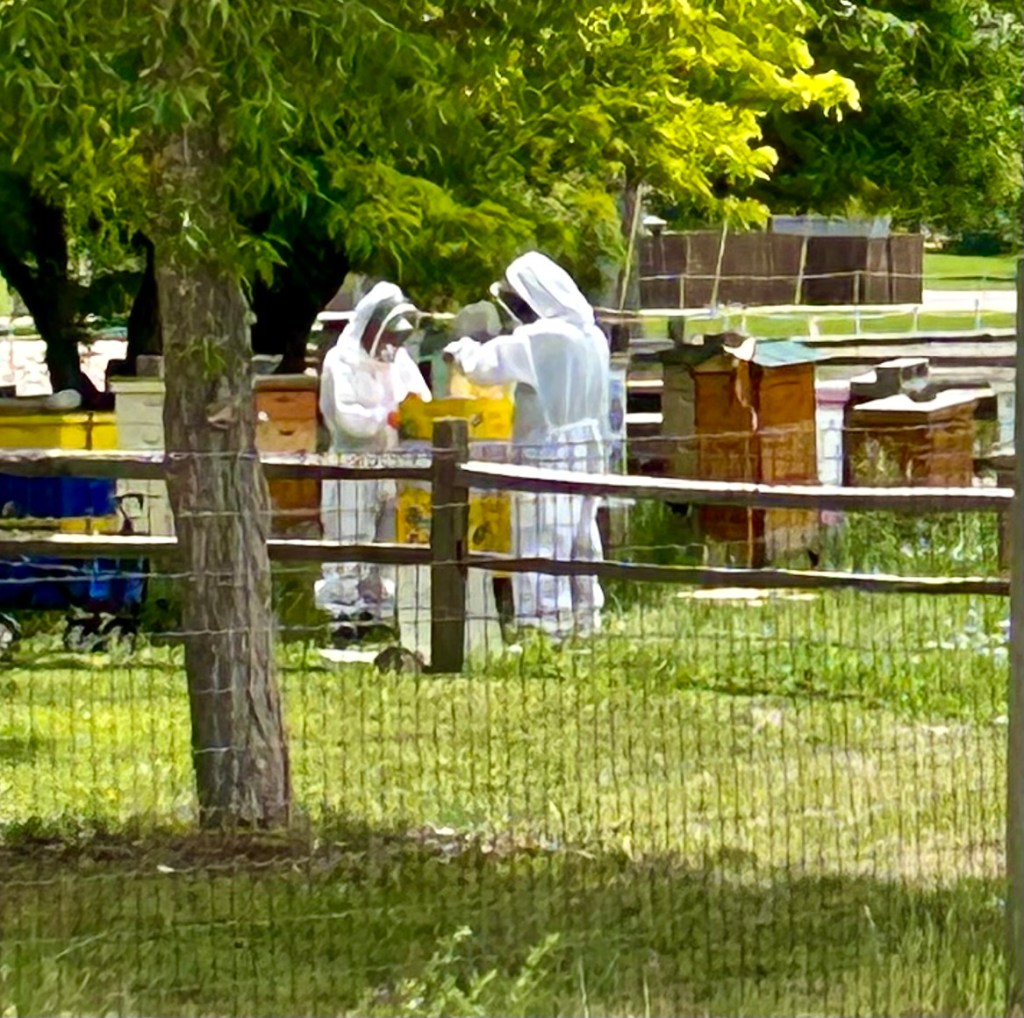
I saw beekeepers at the Hudson Gardens. 

I saw the 154-foot SpaceX rocket booster that arrived at its new home outside of the DISH Network Corporate Offices in Littleton last year. It was impressive! I’ve never found a tax deduction that large. Neither have I ever earned even a fraction of what the Dish chairman has lost. This is a guy who started by selling satellite dishes out of his car in the 1980s before his net worth literally skyrocketed to well over $20 billion a few years ago, according to Forbes. Sadly, he free fell back to earth with a mere $1.4 billion this year. But then, the economy of late has made most of us losers.

Not far from DISH are the benches where men hang out and sometimes build fires, or camp. They may be some of the 600 or so folks DISH has laid off in the last couple of years. I hope not, but as the latest innovation even at DISH illustrates, namely that of the no-dish satellite. No one wants a dish, or a cable anymore I suppose. We want our entertainment coming to our screens from nearly invisible sources, just like it did in the good old days of radio and antennae television. 

I pedaled under a couple more bridges and I was back along the creek. I pedaled past the dog park where a man frequently brings his Mexican wolf. To the dog park. He is the alpha male, obviously—the wolf, not the man.

Toward the end of my ride, I climbed up the hill to the place where a green miniature train follows a track around Belleview Park. Families lay out blankets and picnic along the wide, grassy banks of the creek there while their children wade into the water and squeal. None of them seem to have any idea that only a few months ago the former mini-train conductor was indicted for some sort of cottage-industry mortuary that turned foul; READ: corpses rotting in his hearse and cremations backlogged. (Fiction is less interesting than real life these days.)

I zoomed through the last tunnel. It’s off-and-on strewn with graffiti and then painted over in patches. I rattled across the final wood-planked bridge, and I was back within view of our condo. A birthday party for a three-year-old was just finishing. I braked for kids carrying balloons and packages to the parking lot then panted my way up the last hill to check my mail. I spotted the pickup truck where a woman sometimes lives.

I saw all those things. And I thought I would go on seeing them all summer on those trails. But today I walked by the bike rack on my way to the mail again, and our bikes were gone. The lock cable had been snipped like a string.

###

Minnesota: Land of 10,000 Relatives

There are lakes, too, of course, that’s Minnesota’s true license plate tag line: the land of 10,000 lakes. And beside each of these lakes a family member from my mom’s side likely has a cabin. 

I told my mother I would be her travel companion this September so she could again visit her watery and forested homeland and see all the nieces, nephews, grands, greats, and great-greats. She’ll be 87 this year and all the trouble made these days through TSA, along with the degeneration of the state of air travel that has become more like taking the bus now, is a bit too much for this octogenarian. 

Back in the day, my mom was a stewardess on Continental airlines. From behind her federally mandated COVID mask, she told the Southwest Airlines flight crew this bit of her personal history as we stepped aboard in Denver.

“Her uniform now hangs in the Smithsonian Museum in Washington D.C.,” I explained to reiterate that they had something of a legend on board.

When we disembarked that plane the captain spotted my mom on the way out. 

“How did we do?” he asked. 

She gave him and the rest of the flight crew a thumbs up.

We took an Uber to where the rental car was. Mom stood in the parking lot and asked Jesus to help us. I fumbled around on a newer app I hadn’t used before and wondered why there were so many black Hondas in Minneapolis. But soon enough, we were off, cruising north toward my mom’s hometown of Deerwood, pop. 553.

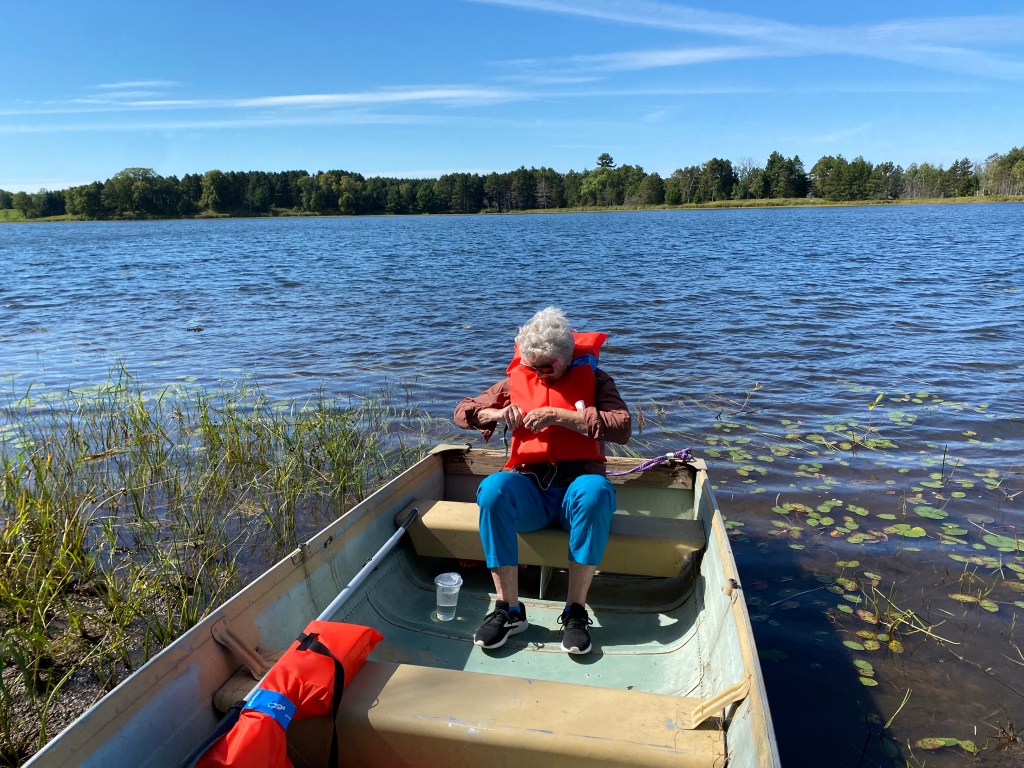
Mom’s getting strapped into her life jacket for our boat trip across Sunset Lake.

Country roads through thick forests of maples, elms, and pine gave way to large lakes with reedy shores. Green hayfields undulated into the distances and eventually led us past my two cousins’ houses and my aunt’s house to a cabin my Uncle Hub and his family built a couple decades before he died. 

The first morning at this cabin on Sunset Lake I sat behind a giant wooden desk writing in the loft overlooking the water. Bright morning sun lit up sparkles across the blue of the water. And having re-read Huckleberry Finn this summer I was a bit intrigued with the island in the middle of the lake. 

About lunchtime I convinced my mom to get into the metal rowboat that lay overturned on the shore at the cabin and adventure out to the island in the middle of the lake for a picnic. It didn’t take much convincing as she is likely the source of some of my adventurous spirit. Getting in and out of the boat was a little tricky for her, but once she was settled, I waded shin-deep into the muddy shore of the lake and tugged at that aluminum craft until we were waterborne.

I couldn’t figure out the oarlocks, so I ended up Sacagawea-style at the bow, kneeling and paddling like I was canoeing through lands yet uncharted with Lewis and Clark.

Mom wanted to take a selfie of us on the island.

Actually, the island is quite familiar. My mom said they used to take her mom there for Sunday outings. We stepped ashore and sat in the tall grass on a beach towel while we ate sandwiches and photographed the views. I found some old songs on Apple music on my phone and that seemed like pure magic to my mom. 

Mother’s prayers were going up nonstop on the way back, especially when we were trying to get her back out of the boat. Finally, I hoisted her up under the arms and she was back on dry land and happier than Magellan to find shore again.

Meanwhile, my lake-water-soaked shoes spent several days drying on the deck and several days convincing me that something had died in my suitcase.

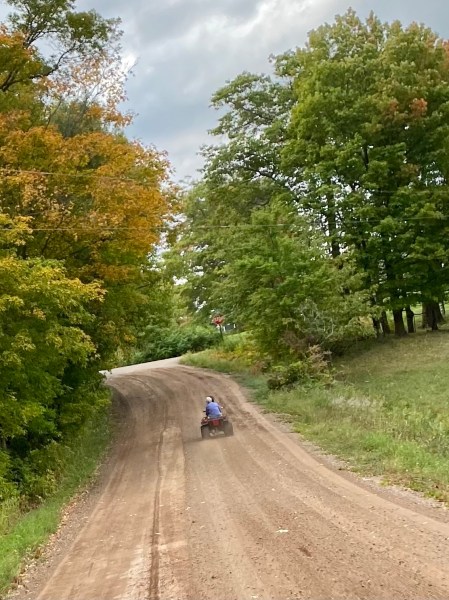
We visited with my Aunt Frannie, and her kids, and their kids, and some of their kids’ kids. We also saw kids and grandkids from my other aunt’s brood. They all drove us around their acreages and farms in ATVs. We went up and down dirt paths through woods, beside rivers where swans swam, through fields of cows and deer, and to other cabins, farms with honey, chickens and ducks, and wood piles that would impress Paul Bunyan. We ate meals together with family I’d never met or hadn’t seen in decades. 

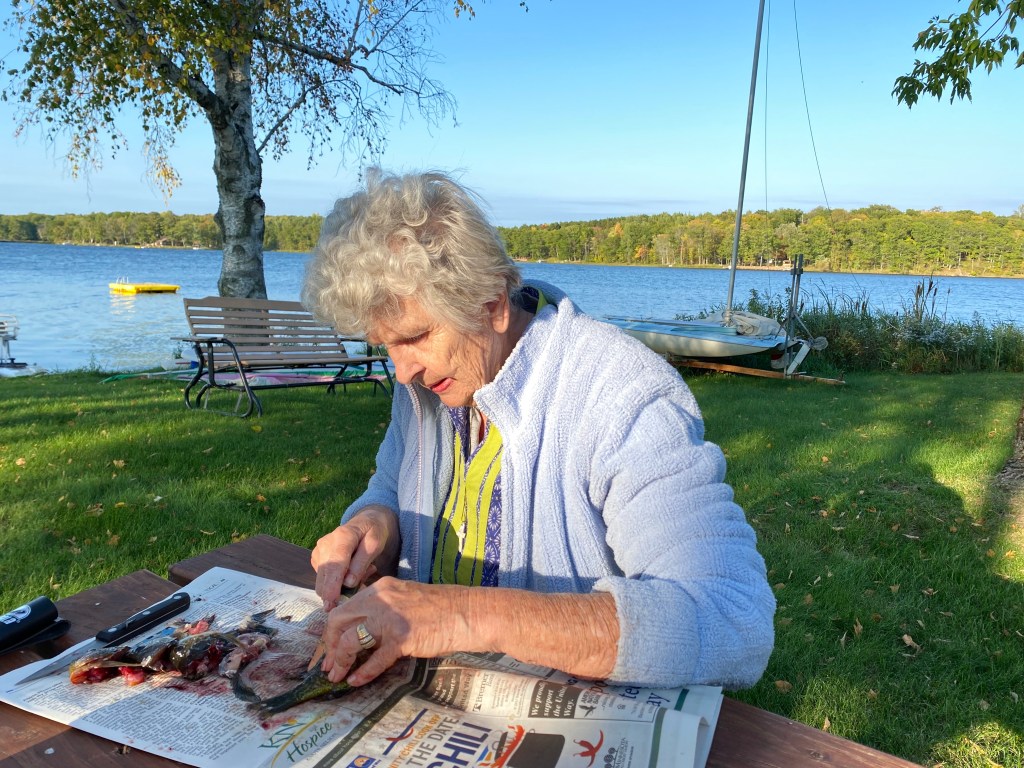
My mom cleans the sunfish and bass she caught in the lake.

My mom caught fish in the lake, and we watched deer parade across the grass and through the forest. As we drove the winding blacktop from one relative’s house to another, we watched carefully as each late-summer day made more and more green leaves turn yellow, orange and bright russet. 

My cousin said she and her family started this cabin as a homeschooling project when her kids were in high school. It’s glampy and adorable.

Two nights we were booked at my Cousin Ginny’s more rustic cabin. We reminisced around a campfire eating s’mores and listening to my mother tell tales of the long, long ago. But the romance of clamping wore off the first night with my mom, for whom outhouses at midnight, loft beds, and carrying in your own water are memories from a poor childhood on a farm, rather than a way of living in her 80s. So, she spent the second night in my cousin’s house. 

I spent a glorious few hours in the cabin alone. Surrounded by trees, the sound of wind in the leaves and birds chirping, I wrote and wrote. Late at night, lying in bed, I listened as coyotes came to dance and sing in the forest.

A dream space for writing.

This introverted moment seemed to surprise some of my relatives, maybe because they are so often surrounded by kinfolk. So, I thought about it a lot. In some ways I always feel alone—even surrounded by so many family members welcoming us into their lives for a few moments, asking my mother about the history of her clan, offering us chicken dinners. We are all part of others this way, but also, separate selves. Maybe, since I’m not from Minnesota, I’m less like a maple tree, dripping syrup into a bucket to boil down and share. Maybe, being from Colorado, I’m more like an aspen, singularly standing beside all the other aspens, yet deep down also linked together with the same roots that bind us all.

The moon over Sunset Lake.

Dear Afghanistan,

Note: I want to write about our next adventure in Nashville, Tennessee, where we landed after Florida, but too much has happened in Afghanistan the past few weeks, so the stories from Music City will have to wait a little. 

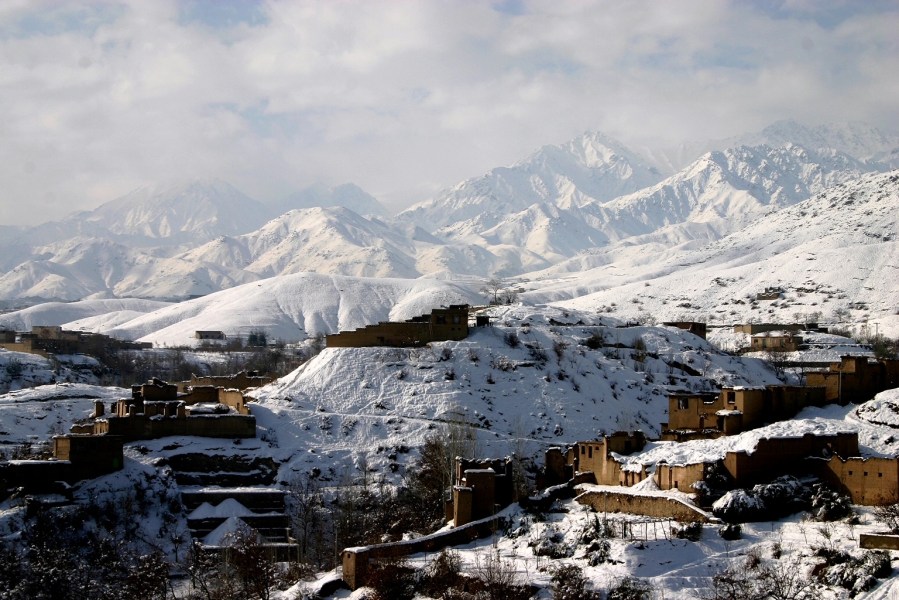
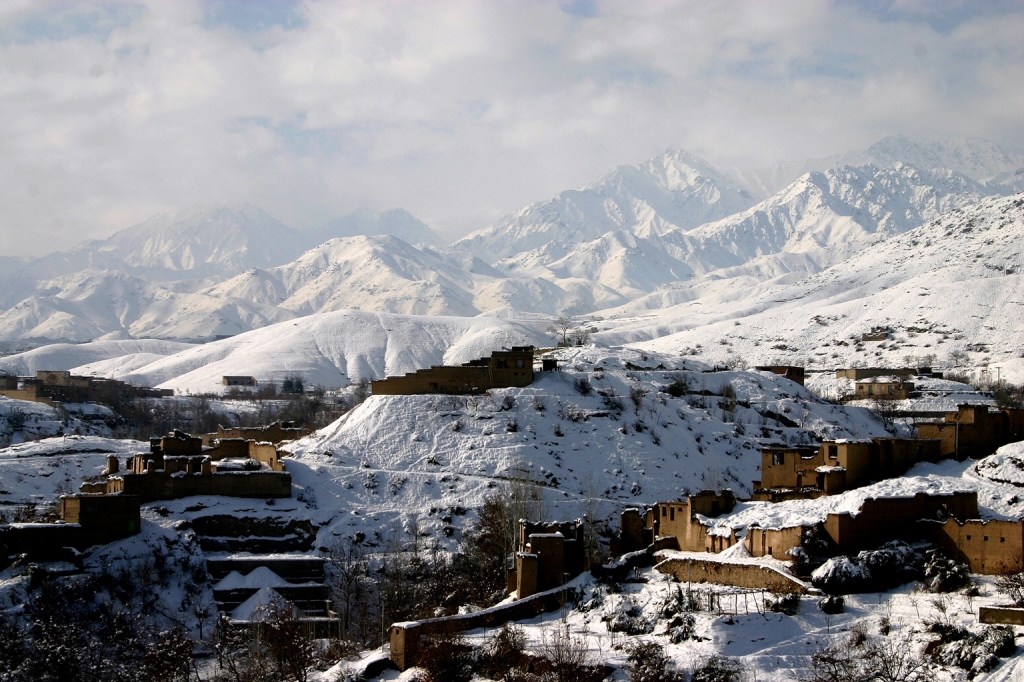
Winter in Istalif, Afghanistan, 2006

The first time I landed in Kabul, Afghanistan, was 2004, just after the Taliban had been ousted from the capital. The airport was barely open, freshly remodeled by bombs and bullets. We landed on a runway flanked on both sides by the wreckage of planes. Little grey donkeys pulled wooden luggage carts to the terminal. Large windows in that building faced the tarmac, but they contained no glass. But as each year went by and we returned to continue helping with humanitarian aid efforts, we saw more and more improvements come to Kabul. The airport got window glass, and mechanized belts for luggage and security, computer systems, and speakers for announcements. 

The streets of Kabul changed too, from mainly rubble and falling down buildings, to large, chrome and glass high rise wedding halls and shopping centers with escalators. Broad avenues were repaired to accommodate all the traffic of Afghans returning home, ex-pats intent on helping to rebuild, and a coalition of military forces patrolling the streets of the city.

We spent our time helping with distributions at refugee camps, visiting medical clinics and hospitals with foreign doctors, and touring schools to teach lessons or encourage the staff with special luncheons. I could tell a thousand stories about any of this. But here is just one.

Each year I visited Afghanistan I made one stop consistently–Chicken Street. In 2004 this market area was a hodgepodge of dusty wares housed in shops that had somehow weathered the bombings of the city. I remember seeing so many strange things. Fur coats hung in one shop window along that street. They weren’t mink, or rabbit, but more exotic spotted and striped furs I couldn’t place—maybe animals from China, my translator thought. In another shop I bought slippers—palace shoes, my translator explained. They were Afghan red, embroidered with gold thread, and pointed at the toes, like something out of 1001 Arabian Nights

Next, was an icon on Chicken Street—Rauf’s rug store. Business picked up here over the years, as well, and when I stepped inside in 2007, I was immediately surrounded by stacks of carpets, mostly Afghan red, piled high all along the walls of the store, and on the floors. They were hand woven, I learned, with the tightest warp and woof and the most intricate patterns. 

Me, sitting on rugs at Rauf’s store in Kabul, circa 2007.

Rauf greeted my friend Wakil with the barrage of pleasantries customary in a country where so many layers of hospitality are interwoven in everyday interactions. The greetings were all in the Dari language, but I knew they were always begun with a wish for peace—Salaam. (It’s ironic that all over this land that is again embedded in violence, people are wishing for peace by just saying hello.)

Rauf asked after Wakil’s health, and Wakil reciprocated. Then, each man asked about the health of every other person connected to each of them—family and friends. (Just stopping by to say hello in Afghanistan can take a while.) And an Afghan would never come straight to the point and begin talking business before firmly reestablishing or establishing a relational connection. 

Anyway, once the greetings were finished, we were urged to seat ourselves on the stacks of rugs and a tray of tea was brought out. Small glasses were filled with steaming drinks and a plate of biscuits (the British style, not the Tennessee style) and some candies in shiny foil wrappers came to accompany the tea. We sipped our tea politely, grateful to our hosts. 

I sat in a headscarf I was constantly adjusting and made sure my legs were not too exposed. (I was wearing pants and a long dress.) It is a conservative culture, and I was many times teetering on the edge of a faux pas I am sure. My thoughts constantly rehearsed what I had been told: Women should avert their eyes from men. Greetings do not involve touching. Clothing should cover everything but hands, shoes, and the face—sometimes the hair can peek out from the top of the forehead if the scarf slips back, but it should be adjusted for modesty, no matter the situation. 

At some point Rauf got the idea that I wanted to buy a rug that was not too big. He began commanding rug after rug to be brought out by black bearded shop men who snapped to obey and trotted into the guts of the store to hoist yet another carpet onto their shoulders. They dramatically unfurled the rug in the middle of the floor just below where I sat. 

I felt guilty shopping this way, in this country, where the victims of war and oppression treated me like an honored guest. But it is their custom. And they are among the best hosts. 

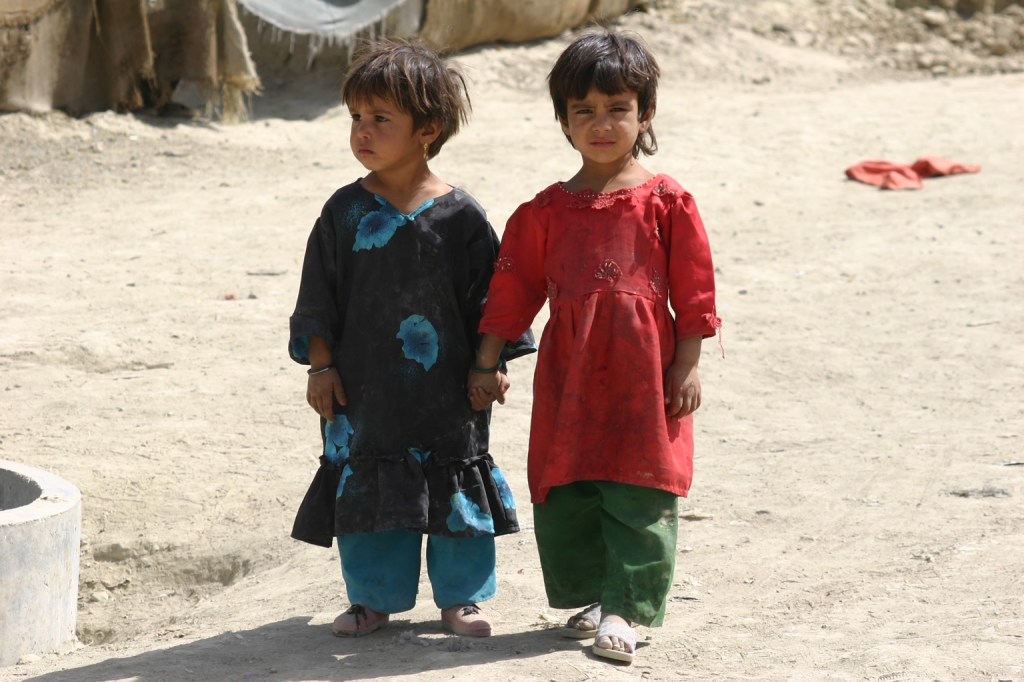
Afghan girls at a camp for displaced people in Kabul, 2004.

When I decided on a carpet, the yelling began. It was a ferocious bargaining in an even more wild sounding language. Wakil and Rauf had switched to their mother tongue—Pashto, a language my Pashto friend likens to nails being dropped in a bucket.

The noise of the arguing must have made my face wince. Wakil stopped for a moment and reassured me in an English aside, that he and Rauf were just playing a game and even though it sounded incredibly angry, it was just Pashto. 

Still, there were likely threats of shame on Rauf’s family for selling a rug for more than it’s worth. And there were equally likely threats of shame for Wakil putting a poor rug dealer out of business.

In the end I came home with a modest-size Afghan rug, mostly black rather than red. I hope I paid a fair price. I’m sitting on it now as I sit in my office desk chair typing this. And whenever I step on it in this room, or vacuum it, or watch my daughter’s cat stretch out on it in the shaft of sunlight that comes through the office window, I think of Rauf, and of Wakil, and of all the Afghans I met over the past 20 years. I hope they can hold on again, like they did before. And I hope they have a rug, too, or at least one thing, one tea glass, one headscarf, or one shalwar kameez, to remind them of their place, and maybe better times that may yet come again.

“The world lives in hope.”

Afghan Proverb